Categories
geology skepticamp

Have I mentioned that I hate public speaking?

Because I do. I really, really do.

For this internship, I’ve had to give four presentations, in front of rooms filled with people I don’t know that well, many of whom seem to delight in asking really hard questions. I guess it’s one of those sink or swim things. Even better, for three out of the four presentations, I had to go first out of my group since it was my responsibility to set up the background for the larger presentation.

So much anxiety.

I think the secret is acting. As in, acting like I’m not someone who is utterly terrified. It seems to be working for me. To the point that statements like, “You know, I wish I could answer that question but I can’t remember at the moment because I’m scared out of my mind,” get treated as laugh lines rather than a pathetic truth. Or maybe everyone just sympathizes.

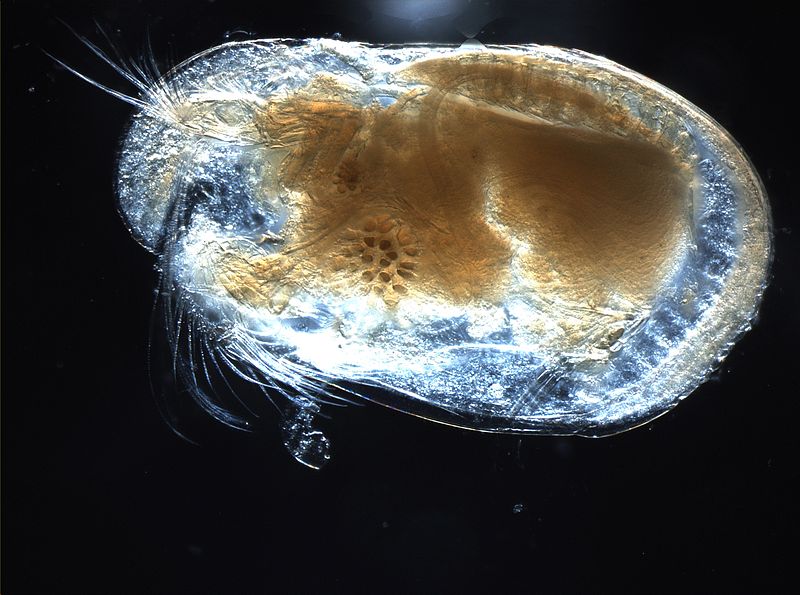
Also, ostracods. Why can’t I remember your name when I’m actually trying to give a presentation, yet it comes popping back into my head the instant I sit down? This has happened all three times I’ve given this presentation. Enough is enough.

I’m grateful that at least I’m no longer paralyzed with vomit-inducing terror when it’s time to give a talk. I can fake being a normal human being who can communicate without looking like she’s about to get strapped into the electric chair.

I think Skepticamp’s helped me with this a lot, actually. It’s one of the few places I’ve ever willingly given a talk, and several times at that. Even if I am, as usual, absolutely terrified while I do it. Though I seem to mask my fear well enough with enthusiasm, from what I’ve heard. My desire to nerd out about something geology-related is apparently enough to get me over the pant-shitting prospect of a room full of people I don’t know who might ask me a question for which I have no answer.

Skepticamp is also where I cemented my bad presentation habit of just throwing slides on the screen and bullshitting at them. Everyone else in my team wrote exhaustive notes to themselves on their slides. I… don’t. Ever. I just make my slides, go through them a few times so I can remember the approximate order (even I know it’s a bad, bad thing to be surprised by your own slides), and then figure if I know the subject well enough, I’ll be able to talk through it just fine when the time comes. So far it’s worked out okay for me.

Except the damn ostracods.

Anyway, I’ve survived the intern forum, which means I’m home free! I have another two weeks at work, but no more presentations, thank goodness. I shouldn’t have to stare Powerpoint in its stinky, evil little eye again until it’s time for me to put together a presentation for my Masters thesis and AGU. (Ah, AGU. I will begin dreading you now so I can pace myself.)

At least there are no ostracods in the Bighorn Basin.

DAMN YOU OSTRACODS!!!!
Categories
geology history trip report

Welcome to Silent Hill, PA

It’s May 3, 2012. Ten hours to go until the US premiere of Avengers and I’m in central Pennsylvania with a group of friends specifically to see that movie. How to pass the time?

Well, the native of Pennsylvania (my dear friend Rynn) mentions that we’re maybe an hour away from Centralia.

If you’re not a fan of horror videogames or somewhat obscure but recent east coast history, Centralia probably doesn’t ring any bells. It’s the town that was devastated by an underground coal fire. It’s a haunting place where white smoke stinking of sulfur billows from the ground itself and the roads collapse as the fire continues to eat its way through the coal veins. Trees in the area are bleached and blasted by the fumes.

Centralia was the inspiration for the fictional town of Silent Hill, which spawned a successful franchise of survival horror videogames as well as a somewhat less impressive movie. In the original game (Silent Hill) and the movie, it was clear that the billowing white fog engulfing the town was actually smoke and ash from the underground fires. In later games, the fog was left to be more traditional water vapor and the mining town history fell by the wayside.

Needless to say, as a fan of the games, I leap at the chance to see Centralia.

If you’re expecting someplace as haunting and creepy as the video game setting, I can’t guarantee that Centralia will deliver. On the day we go, the fires aren’t burning with particular ferocity – the air is almost entirely clear. It’s sunny and more than a little muggy, the surrounding hills bursting with plant life in a way I’m still not used to as a resident of Colorado. But the trip is perhaps more interesting because it’s nothing like what I expect.

There are two halves to a look at Centralia. There’s the town itself – or what’s left of it – and a closed-off portion of road that used to be part of Route 61.

The actual Route 61 now circumvents this section, swinging wide between two hills to avoid the slowly extending fire damage that undermines the landscape. But if you follow the road north out of Ashland, you’ll come to a cemetery at the top of a hill before you hit the next town. Park nearby and the old section of Route 61 isn’t hard to find.

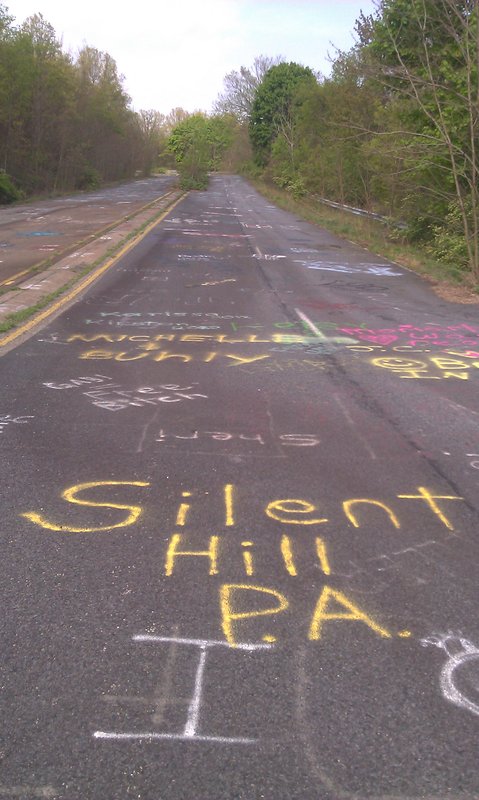
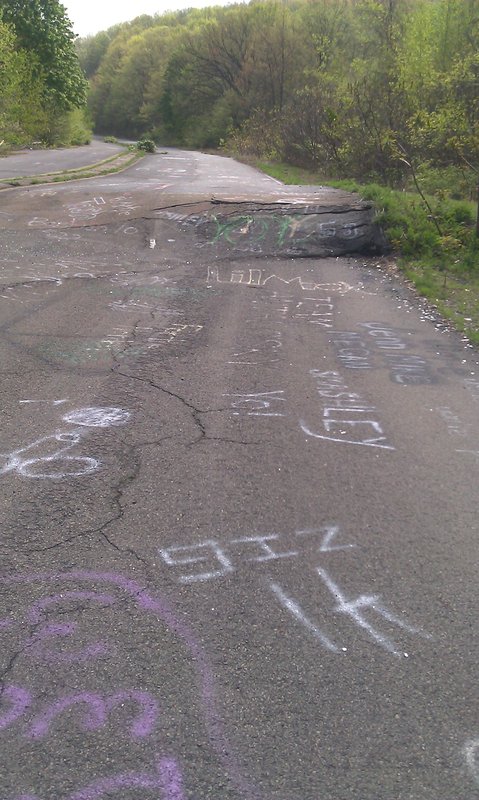
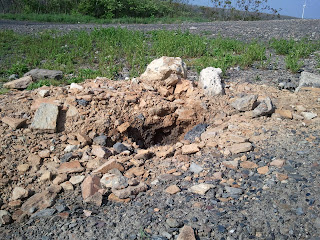
It’s utterly deserted, but you can still hear the sounds of traffic from the nearby reroute. The road itself is covered with graffiti. Apparently when you’re a teenager in rural central Pennsylvania, this is what you do for a good time on a Friday night. Most of the graffiti is penis-based, or names and dates from visitors. There are a disturbing number of swastikas that have been drawn on the asphalt. And here and there are nerd shout-outs to the other reason people come here, the one that doesn’t involve drinking and drawing cartoonish genitalia – Welcome to Silent Hill, PA and There was a hole here. Now it’s gone. The road surface buckles, wavers, and cracks, broken-up graffiti showing that the surface destruction is recent and continuing as the subterranean fires march ever onward.

I think in the future, I’m going to have a hard time seeing how clean the roads look in post-apocalyptic future visions. Because if there is even one remaining teenager in the world, and one remaining can of spray paint, it seems almost inevitable that things will end up covered in dicks.

Getting into the remains of the town itself requires backtracking and going around the side of the hill. Rynn’s GPS unit still shows the ghost of streets that no longer exist. At the base of the hill, a few houses still stand, and are obviously occupied. The rest are empty lots surrounded by low stone walls, showing where houses once existed.

Further up the hill, the destruction of Centralia is total, and largely man-made. If the streets were ever paved, they aren’t any more. It’s dirt and gray gravel now, slices of thinly-laminated black shale showing through where runoff has carried away the surface soil. The black shale crawls with tiny, bright pink mites that look like they should belong to a 1980s Atari game.

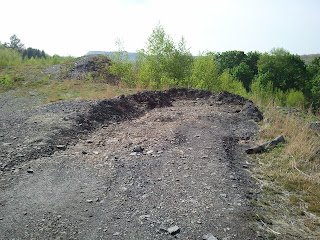
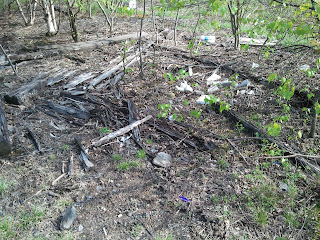
There were obviously once houses up and down this hill, but nothing remains, just flattened lots that have plainly been bulldozed.

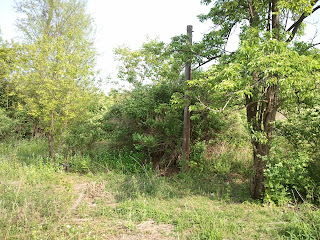
Broken up bricks and concrete are still visible, the remains of walls and foundations that haven’t been completely removed. The ground is littered with broken glass and shotgun shells; I guess since unpaved tracks don’t provide the same graffiti opportunities, this part of the disaster is used as a shooting range. Strange little bits of civilization still peep out of the surrounding trees, like this wooden utility pole.

This is where it finally begins to feel eerie, seeing these ghostly remains of what was once a town. There are a lot of reasons for the government to have seen to the destruction of the unoccupied houses. With toxic fumes rising from the ground, allowing abandoned buildings to stand and invite squatters is a potentially lethal proposition. They’d be fire hazards. And it’s a way to discourage gawkers like myself from picking over the bones of Centralia.

But all the same, it’s disquieting to see there was once life and it has been so plainly removed.

And even on this clear, beautiful day, there is a reminder of the fires that still rage through the coal seams. Smoke isn’t billowing, but the air smells faintly and pervasively of sulfur. There are holes in the ground from which wispy smoke drifts. Like a ghost, it doesn’t photograph, but it’s there to see with your own eyes.

Seeing smoke come out of the ground is something that disturbs a deep, primal portion of your brain. The smoke stinks like matches, and you know that’s bad and you really should just get the hell away. Even worse, when the breeze shifts and the smoke washes over you, it’s notably hotter than the muggy air. You feel it like breath on your face.

And you let yourself imagine that this might just be a little hint of hell. Because an endlessly burning, unquenchable fire that burns slowly underground, eatings its way through the bones of old trees certainly fits the bill. In that moment, sunny day or no, you’re still waiting to hear the old air-raid sirens.

Epilogue

There’s something else you can see from the ruins of Centralia, which sums up so much of the way the region feels to an outsider like myself.

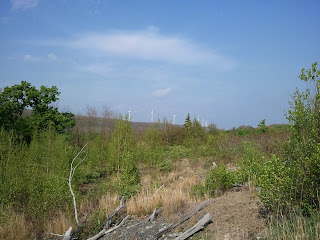
Throughout the region, there are enormous, flat topped tailings piles, the remains of open-pit mines where machinery has chewed up all the coal and spat out the pieces we didn’t want to burn. They are ugly sores on the landscape, though you do see places where plants have begun to move back in. From Centralia, standing in the bulldozed shadow of a house, you can see one of these flat-topped monstrosities lined with the graceful white forms of enormous windmills, blades turning slowly in the breeze.

With the stink of sulfurous coal smoke permeating the air, the windmills really do feel like a distant promise, one that you might be able to reach if you can just stretch your arms far enough.

For a little more about the history of Centralia and its underground fire here is one site.
For the rest of my pictures from Centralia you can look through my online album.
Categories
geology

Spec Tech post up

Okay, a little belated, but I wrote a post for the Clarion blog about sandstone as a building material, since a commenter had asked about it a while ago: Sandstone: It’s a Living.

My next post will be due mid-December… I’m trying to decide what to write about. I’m kind of tempted to talk about undersea hydrothermal systems (black smokers, white smokers, carbonate chimneys) because they’re really cool. And it lets me share something I’ve learned in oceanic geochem this semester.

Categories
bbcp climate change geology petm

I’m Going to Wyoming, for SCIENCE! (and this is why you should care)

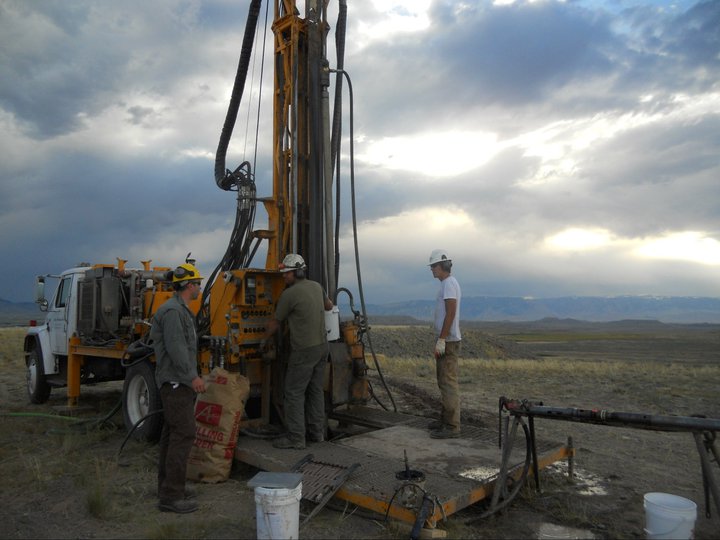
In a few short hours, I’ll be on my way to the Bighorn Basin in Wyoming, to participate in the coring portion of the Bighorn Basin Coring Project. Things are moving much faster than expected – the rig is already at Polecat Bench, where it wasn’t planned to be until Friday, because coring went so quickly at the first location, called Basin Substation.

(All of the amazing pictures for this post taken from the BBCP Facebook page.)

This was kind of a surprise, but a good one. It also means my advisor and I are scrambling to get up to the Basin as soon as we can. And that instead of one two week stretch, I’ll be coming back to Denver with her, and then flying back out to Wyoming on July 31 to help out at the third site. (The third site, Gilmore Hill, is on BLM land and we’re literally not allowed to start until August 1.)

I’ve set up a twitter account for just BBCP-related stuff. I don’t know how many good pictures I’ll get, since I’m on the nightshift, but here’s hoping! Please follow and spread the word. It’s a chance to see some science in action.

So why should you care about this project? Two words: climate change. In geology, the present is often the key to the past – we can observe processes today and use them to figure out the how and why of ancient rocks. During the PETM, the Earth’s climate changed remarkably, and in a fairly short period of time. I’ve written about it in more detail here, and you can also get more information on the project’s website. While the Bighorn Basin Coring Project is focused on understanding the PETM and many related issues, there is also this to consider:

This will allow us to investigate, in an unprecedented way, the high-frequency climatic and biotic variability of a continental depositional system during greenhouse conditions.

There are no guarantees in science, but there’s a possibility that this time, the past might provide a key to the present. Climate change induced by a rapid influx of greenhouse gases into the atmosphere? While it’s not a perfect parallel (for the PETM it was methane, rather than our own carbon dioxide), it still could be very relevant. And I would think it’s something we want to understand well before our personal contributions of carbon get anywhere close to the rather voluptuous 6800 gigatons of methane that went into the atmosphere during the PETM. (As of 2004 we were at ~500 Gt.)

One thing we’re hoping is that we’ll not only capture the PETM, we’ll also maybe get some data for the other, smaller hyperthermals in the Eocene. How much carbon input equals how much climate change? As part of a species with a vested interest in climate not changing much, that’s a question I’d personally like to examine, and I’m hoping I’ll get my chance.

(And don’t worry, Mom, I’ll watch out for snakes!)

Categories
geology writing

New Spec Tech Article Online!

Actually, it’s been online for a few days, but there was this whole TAM thing (you may have heard of it) and I had no real internet access for four days because the Southpoint Casino is run by vampires1.

It’s 1000+ words about tuff, which is a good example of how geology influences culture. And there are also bad puns. Because, you know, tuff: The Whole Tuff and Nothing But the Tuff

1 – Leave my non sequitor alone. Something about bloodsuckers. I’m tired.

Categories
geology skepticism

Creationists at GSA

I didn’t actually go to GSA, even though it was in Denver. Mostly because I didn’t want to cough up the registration fee, and had projects I should be working on besides. And of course, no one I know heard about this at the time, probably because I don’t think people tend to get excited about field trips into their own backyards when it costs money.

But apparently, there were young earth creationists at GSA. And they ran a field trip to Garden of the Gods without telling anyone that they were young earthers. And then later bragged about how convincing it was to the real geologists. Please see PZ’s blog post, since he’s already done a lovely job of laying it all out and I see no reason to reproduce his links and do my own less entertaining version of the commentary.

I’ll just note here for anyone not familiar with the geology of Colorado, that the pretty bits of Garden of the Gods are mostly from two formations: Fountain and Lyons.

The Fountain Formation is a series of alluvial fan deposits that run up and down the Front Range of Colorado (and have a sister formation on the western side of the continental divide, called the Maroon Formation) which was laid down on a probably dry plain at the feet of the Ancestral Rocky Mountains. The formation was mostly deposited by flash floods screaming out of mountain canyons, carrying loads of poorly sorted sediment. So in it, you see rocks ranging from conglomerates to sandstones to mudstones, which vary depending upon which flood stage they were laid down in. And you see these layers repeated over and over. You also see some very nice sedimentary structures that indicate successive floods, such as scours and channels cutting through lower layers.

So technically, the Fountain Formation was laid down by water, but it was fresh water. Fresh water in what was likely an otherwise dry environment. And it was also technically laid down by flooding, but by a lot of flash floods rather than one enormous Noah’s flood. I think trying to fuzzy the two together is pretty disingenuous.

And then there’s the Lyons. The Lyons is a quartz arenite, which means it’s almost pure quartz. All the grains are super well-sorted and well-rounded. (And those of you that remember undergrad sed/strat are probably now nodding your heads, because you know what sort of thing typically makes these deposits already…) It’s got enormous cross-beds as well as fissile ripple laminations that occasionally show as classic reverse-graded pinstriping, though pinstriping in the Lyons is much less common or pronounced than it is in other similar formations.

Dunes. In a desert. Giant sand dunes. We see formations like this all over the world, and we understand pretty well how they form.

I personally have a very, very hard time believing that any honest (as in not self-deluding) geologist who can even dimly remember anything about undergrad (let alone graduate) sedimentology/stratigraphy would look at the Lyons in particular and say, “Oh yeah, totally a giant flood.”

But it sounds like the young earthers spend a lot of time muttering their more wacky assertions or dropping them in to the discussion quickly and moving on, so those not listening for it just didn’t notice. From the article in Earth magazine, that’s certainly what it sounds like.

The Earth article also makes this point:

Creationists may come to conclusions that the geological community challenges, but as long as they present their conclusions as derived from accepted scientific methodology, rather than religion, it is unfair to reject their participation. In any event, the field trip I attended was not a platform for proselytizing to participants, but involved real observations on real outcrops — even if the perspective was slanted towards a nonstandard interpretation. No harm, no foul.

To me, this seems like a really tricky thing. Because Mr. Newton makes a good point that completely excluding the young earthers from meetings isn’t really going to do us much good. It just gives them ammunition. And to a certain extent, I think it’s healthy for geologists who aren’t necessarily involved in organized skepticism to run across young earthers, because if you’re in academia it’s pretty easy to forget that cranks like this exist or just dismiss them out of hand. They’re a lot harder to forget if you’re actually confronted with them and forced to consider what they’re claiming, which then calls for a response.

On the other hand, what causes the downside of participation is the basic dishonesty the young earthers displayed at GSA. They’re not being upfront about what their driving hypothesis is. They’re being very subtle and cagey about their most scientifically insupportable views, and then running off to claim that they’ve convinced people. Because let’s be honest, it’s pretty easy to nod vaguely at a poster at GSA or AAPG or SEG or any other meeting when it’s extremely technical and not precisely your area of expertise; it’s easy to make fine details sound reasonable when the main crux of the research – trying to prove a young earth – is hidden precisely to prevent academic disagreement.

There’s not any easy answer to this problem. You can’t really make young earthers wear dunce caps at meetings, as amusing and righteous as that idea must feel, because it ultimately leads to the same place as excluding them entirely. I think maybe the best solution would be outreach and education to let geologists know that hey, these people are out there, and by the way, they’re coming to meetings to try to give themselves a veneer of credibility so you ought to pay attention. Not that I think turning GSA into a pit of seething hostility is the way to go, but it’d also be a good idea to make sure people know why there will occasionally be confrontations at presentations. And also maybe give some hints on how to be listening for the subtle, cagey distortions that are apparently all the rage.

Ultimately, it’s just a bitch and a half to try to engage in a scientific debate with people who aren’t being up front and honest to begin with. But I think this also makes the point that we need to be a little more cautious about our nods of vague approval when we’re browsing the posters.

Thoughts?

Categories
geology pictures

Geology photos for you…

It’s been a long, long weekend. I am only slightly sunburned, but my brain has melted. Have some photos:

Core photos:
Orchard Core
Almond Core

These are the two cores that were the final project for the facies analysis class I took last semester. Lots of pretty sands and muds.

Snowmastadons – these are pictures I took of some of the fossils recovered in Snowmass. I had the privilege of seeing them while I was at the Bighorn Basin Coring Project meeting at the Denver Museum of Nature and Science. The pictures really don’t do these amazing remains justice. For more information, please see the Snowmastodon Project at DMNS. There are a lot of absolutely amazing pictures of the dig site and more fossils there.

The Amazing Kung Fu Adventure in Moab – the Shaolin Hung Mei Kung Fu School went to Moab this Memorial Day weekend to perform at the Moab Arts Festival. While we were there, we spent a few hours at Arches, and I got some beautiful pictures. I love Moab so much.

Categories
geology petm

Magnetic Bacteria Fiesta on the Proto-Potomac

I met with my advisor last week, and she asked me to do some background research for her on a couple of papers she’s working on. So I spent the last week-ish doing a lot of searching across the internets for papers, and then reading of papers. Considering how I feel about reading most papers, this was no small task. My schedule pretty much ran like this:

Wake up
Read papers until brain melts
Lunch break
Read more papers until hysterical giggling starts
Afternoon walk
Read papers because we live in a godless universe of pain
Mike gets home, incoherent gibbering commences

But I got this round done, and my advisor is pleased with my results so WOOOOOO GO ME. And here’s a tip for my fellow newb grad students – get yourself a copy of the John Williams Superman theme song. Play it while you’re writing, and then it feels like not only are you doing science, you’re SAVING THE GODDAMN WORLD OH YEAH.

So anyway, I wanted to share with you all my favorite paper I read over this last week:
An Appalachian Amazon? Magnetofossil evidence for the development of a tropical river-like system in the mid-Atlantic United States during the Paleocene-Eocene thermal maximum (Kopp et al 2009)

I don’t think you’ll be able to read the entire paper without an AGU membership (or without using a university library computer), but if you can give it a read. It’s a fun, fun, fun, and cool paper. The summary goes like this:

1) At the PETM in the Salisbury Embayment (which runs from northern Virginia to southern New Jersey on the Atlantic sheld) there’s a clay layer called the Marlboro, which is “…the thickest single-domain magnetite-dominated sedimentary unit yet reported in the literature.”

2) The magnetite is all from magnetofossils produced by bacteria and other organisms that need crystals of magnetite for their own nefarious purposes.

3) The conditions necessary for that kind of bacterial block party are pretty specific, since it’s got to be conducive to the little critters being able to live and make their magnetite.

4) Hey, in modern day, the best example of these conditions are tropical river shelves, like the Amazon shelf. So what if the Potomac during the PETM was like that?

Of course, there’s a lot of really fascinating detail from the paper that I’m leaving out. But even just the concepts are awesome and interesting.

Categories
geology geomorph

Slow Motion Landslide

This is just awesome:

The flow looks like it’s really cooking along… until people make an appearance in the video and you see just how much it’s been sped up. The flow is actually moving at around 50 cm per hour, which to us fast-living humans makes it practically solid ground.

More info over at the AGU Landslide Blog.

And I totally agree with the first commenter over at the post. This thing needs some Benny Hill music, starting right when the first person pops into the frame. WIN.

Categories
geology writing

Spec Tech Article Online

When I first joined the SFWA, I admitted on their forums that I’m a geology sort of person. This eventually led me to being contacted by the wonderful lady that runs the Clarion Foundation Blog and offered the chance to write the occasional bit about geology. My first piece is now up over there:

The Making of Mountains

It’s a basic overview of the tectonic processes that are involved in creating most mountain ranges – and what those mountain ranges generally look like on maps. Which I hope will be helpful for people who are worldbuilding.

Not that I’m implying anyone making a map for a fantasy world is at all interested in realism, or ought to be. If your mountains are that way because the god that created the world wanted them there, good for you.

But I’ll admit, there’s been a time or two where I’ve looked at a map for a fantasy world and giggled – I’m looking at you, Mr. Tolkien. Which is silly, I know, since this is fantasy. But what can you do, I guess we each have a little item or two that just destroys the suspension of disbelief. It’s the same reason I can’t look at maps from WoW without snickering – I could practically write a book about how silly they are.